
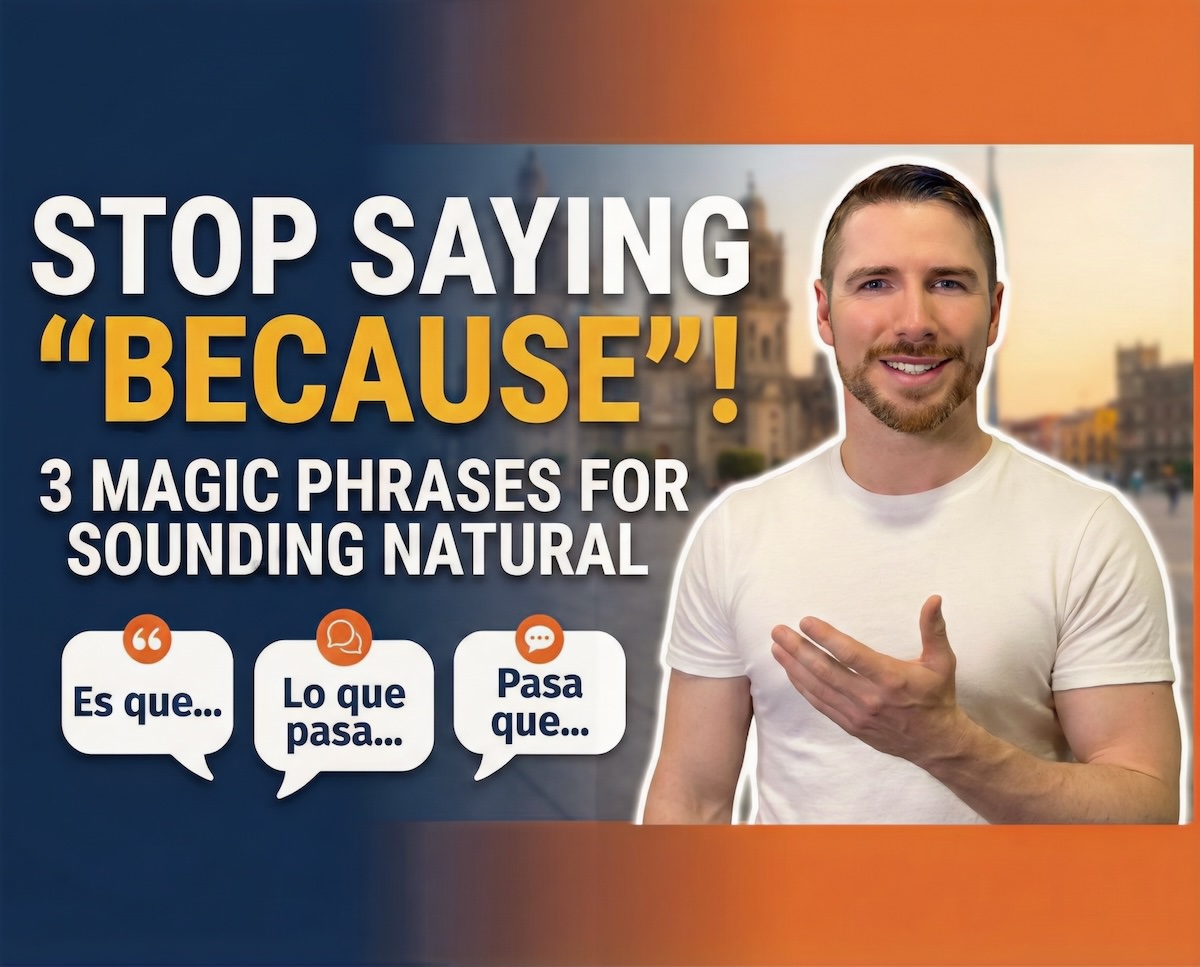
Three Tiny Spanish Phrases That Instantly Make You Sound More Natural

Have you ever been asked a simple question in Spanish—“Why were you late?”—and suddenly your brain freezes?
You know what you want to say.
But instead of sounding relaxed and natural, your answer comes out stiff, robotic, or overly direct.
The truth is, Spanish speakers rarely jump straight into “because.” Instead, they soften their explanations with a few tiny phrases that add politeness, hesitation, and humanity to what they say.
In this lesson, you’ll learn three of the most powerful ones:
- Es que – “It’s just that…”
- Lo que pasa es que – “The thing is…”
- Pasa que – “Happens that…”
These phrases show up constantly in real conversations across the Spanish-speaking world—and knowing how to use them will instantly make your Spanish sound more fluent, more natural, and more human.
If you’re new here, we’re Jim & May from Spanish and Go—we help travelers and language learners speak real-world Spanish with confidence.
1. “Es que” — The Softener That Buys You Thinking Time
Literally translated, es que means “it’s that,” but functionally it works like:
- “It’s just that…”
- “The thing is…”
- “Well, it’s because…”
Spanish speakers use es que to introduce a reason without sounding abrupt or defensive. It’s one of the most common conversational softeners in everyday Spanish.
Common Uses of “Es que”
1. Gentle explanation
¿Por qué no contestas mis mensajes?
Why don’t you answer my messages?
Es que estoy estudiando para un examen.
It’s just that I’m studying for an exam.
Instead of sounding cold, this feels human and relatable.
2. Polite refusal
¿Vas a venir mañana?
Are you coming tomorrow?
Es que tengo que estudiar.
It’s just that I have to study.
You’re saying “no,” but kindly.
3. Soft correction
Es que así no se dice.
It’s just that that’s not how you say it.
You’re correcting someone—but without sounding sharp or rude.
Common Mistake to Avoid
Don’t double the “that” in English:
❌ It’s just that that I can’t go.
✅ It’s just that I can’t go.
2. “Lo que pasa es que” — When You Need a Longer Explanation
If es que is short and quick, lo que pasa es que is its thoughtful, story-based cousin.
It translates best as:
“The thing is…”
This phrase is perfect when your explanation is longer, contextual, or emotional. It frames what you’re saying as part of a bigger situation—not just an excuse.
Examples of “Lo que pasa es que”
¿Vas a venir a comer con nosotros?
Are you coming to lunch with us?
Lo que pasa es que tengo muchísimo trabajo hoy.
The thing is, I have a ton of work today.
¿Por qué no me llamaste?
Why didn’t you call me?
Lo que pasa es que estaba ayudando a mi hermana a mudarse.
The thing is, I was helping my sister move.
This phrasing:
- Builds empathy
- Feels reflective
- Sounds reasonable instead of defensive
Grammar Tip
After lo que pasa es que, you can use any verb tense normally—no tricky subjunctive changes are required.
If you like this kind of practical grammar, you’ll also enjoy:
3. “Pasa que” — Ultra Casual, Ultra Relaxed
Now we drop into super informal Spanish.
Pasa que is the shortened, casual version of lo que pasa es que. You’ll mostly hear it in relaxed conversations between friends.
It feels like:
- A verbal shrug
- A quick explanation
- Something said while smiling or laughing at yourself
¿Por qué no entraste?
Pasa que me distraje y seguí caminando.
While this phrase isn’t very common in Mexico (where we live), it’s widely used in other Spanish-speaking countries like Argentina and Chile.
Use it casually—not in professional or formal settings. For more vocabulary from Argentina, explore our guide to Argentine slang.
Why These Phrases Matter So Much
Native speakers rarely sound blunt when giving explanations. These phrases:
- Soften your tone
- Make you sound polite without effort
- Help you gain thinking time
- Make your Spanish feel human instead of translated
If you always answer with a rigid porque…, your Spanish will be understood—but it won’t sound natural.
These three phrases fix that instantly.
Quick Practice Challenge
Try answering this question using one of the phrases:
¿Por qué no estudias español todos los días?
Why don’t you study Spanish every day?
Examples:
- Es que trabajo demasiado.
- Lo que pasa es que me distraigo mucho.
- Pasa que se me olvida.
Say your answer out loud—fluency is built in the mouth, not just the head. Then try using an explanation in a longer exchange with our Spanish small-talk practice topics.
Free “Es que” Cheat Sheet
Want a quick-reference guide you can keep on your phone?
We created a free printable cheat sheet with:
- When to use each phrase
- Natural example sentences
- Common mistakes to avoid
- Pronunciation tips
👉 Enter your email below and we’ll send it straight to your inbox.
You’ll also receive occasional Spanish tips and travel stories from us—no spam.
Practice With Real People in La Escala
If you’re serious about actually speaking Spanish, join La Escala, our supportive online Spanish-speaking community.
Inside La Escala, you get:
- Real-time feedback on your Spanish
- Guided conversation practice
- Weekly speaking opportunities
- Support from learners around the world
- Help directly from Jim & May
🎁 Launch Gift: The first 50 members receive 50% off their first payment.
Be sure to use code ESQUE50 when sign up!
Take It Further With Total Immersion in Mexico
Want to use these phrases all day with real locals?
Join us on one of our Spanish Immersion Retreats in Mexico, where you:
- Speak Spanish daily
- Explore real neighborhoods
- Learn through culture, not classrooms
- Build confidence fast
👉 View Upcoming Spanish Immersion Retreats
Final Takeaway
You don’t need massive vocabulary to sound fluent.
Sometimes, all it takes is one small phrase in the right place.
Start using:
- Es que
- Lo que pasa es que
- Pasa que
…and you’ll immediately sound more natural, more polite, and more like someone who actually lives in Spanish—not just studies it.
Related Posts
How to Type Spanish Accents on Mac and iPhone
How to Say I Don’t Understand in Spanish: 7 Different Ways
The 10 Most Difficult Words to Pronounce in Spanish